
A transport infrastructure scheme is not a building site with a longer fence. It is a corridor, often several kilometres of it, crossing multiple landowner boundaries, several local authority areas and a string of separate compounds, with plant, fuel and cable-heavy materials moving between them every day. The controls that work behind one perimeter fence, a single gate and a static guard on a conventional build do not scale to that geography, and a security specification written as if they do leaves long, unwatched stretches of the site exposed. This article sets out what security and logistics risk actually looks like on rail, road and other major linear infrastructure projects, and what a main contractor or site services buyer should be specifying before mobilisation, not after the first theft.
Why a corridor is a different problem to a compound
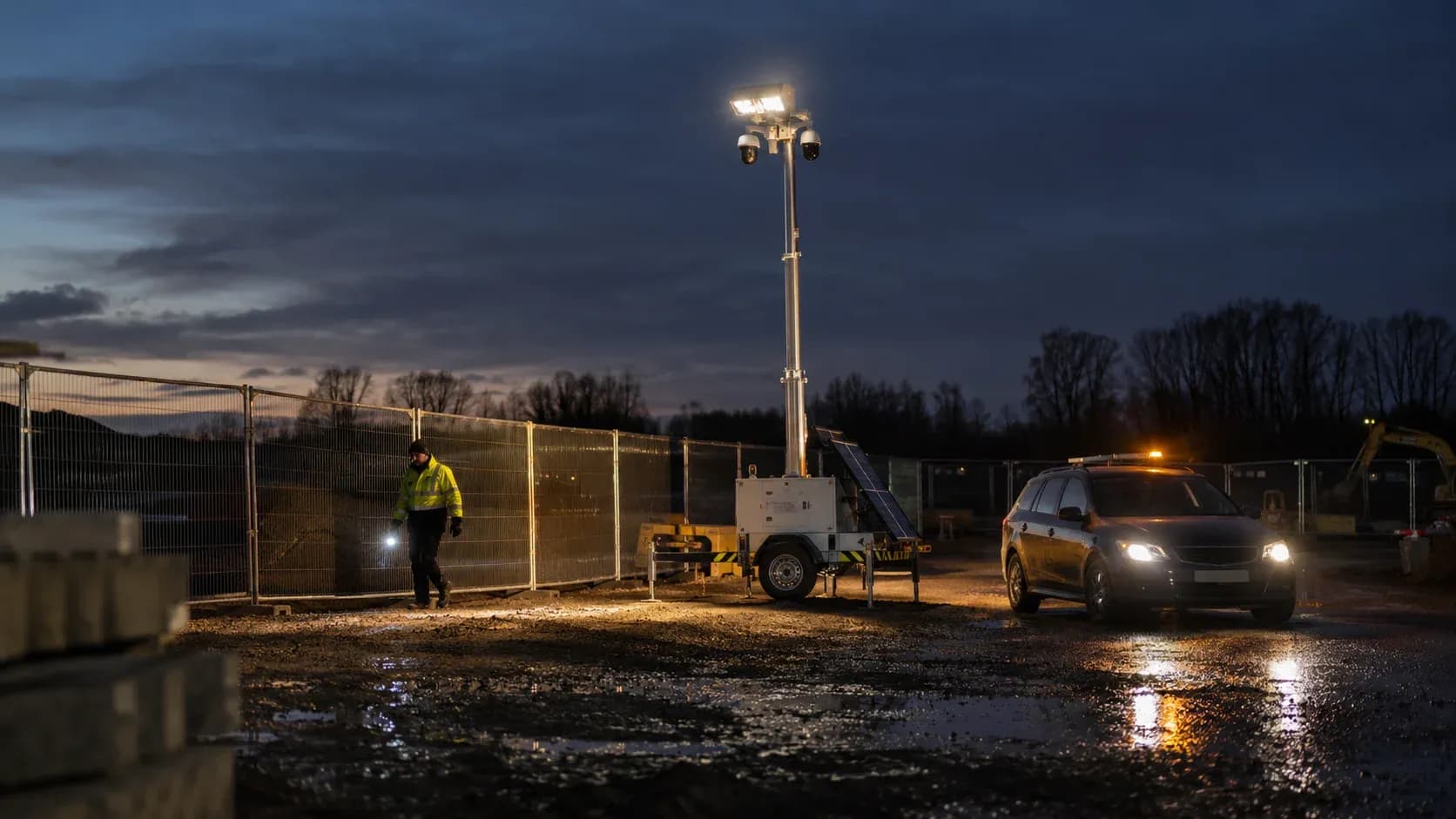
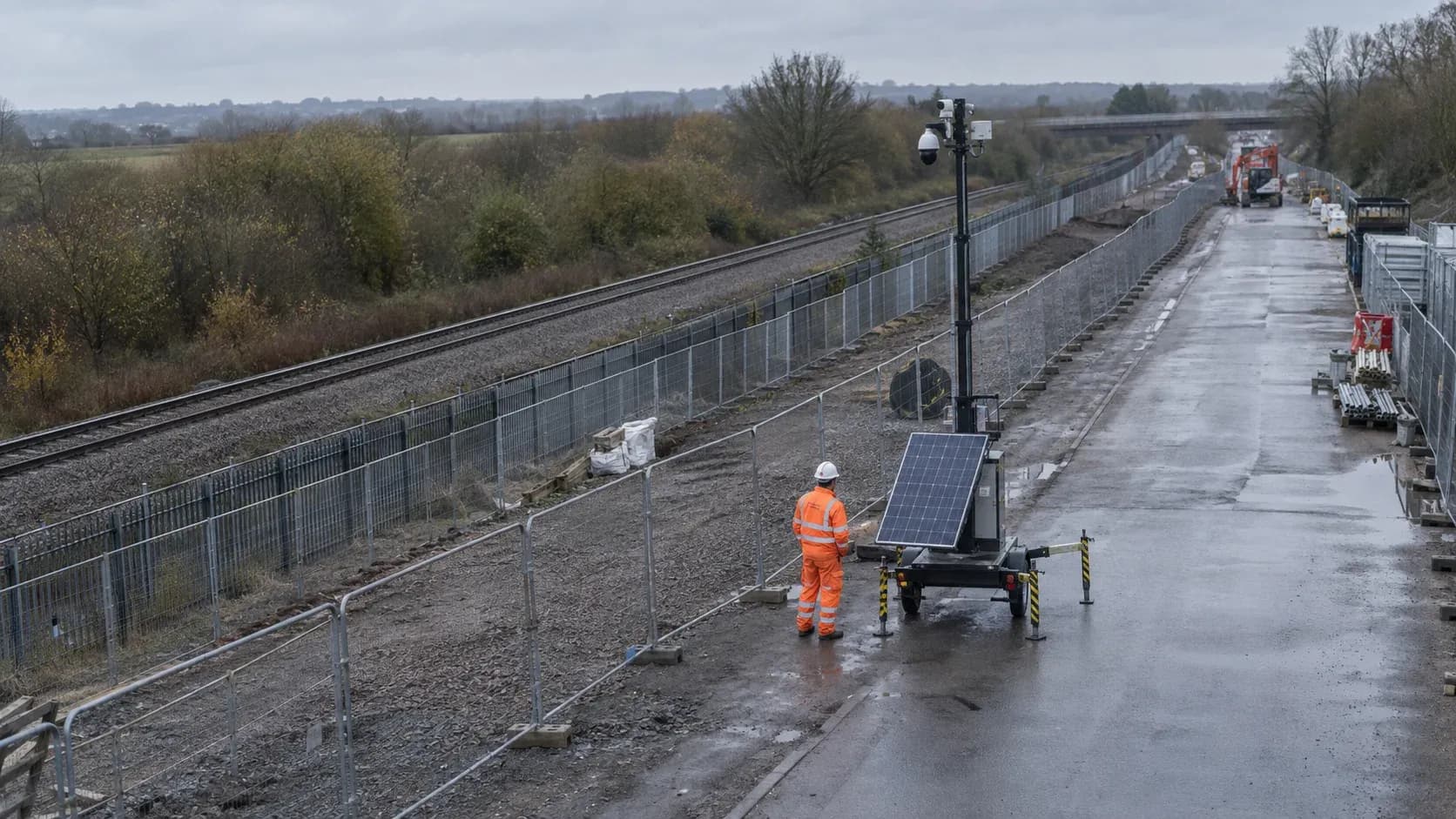
A single-building site has one boundary to defend and, usually, one main point of vehicle access. A transport corridor has many: temporary compounds spaced along the route, multiple contractor and subcontractor camps, borrow pits and laydown areas that open and close as the programme moves, and long stretches of fencing or hoarding running alongside public roads, footpaths and farmland where nobody is watching after the shift ends. On HS2's Staffordshire section, for example, the two construction compounds either side of the A515 needed a 24 hour on-site security team as a baseline, but the rural landscape still left several points of access and blind spots that fixed cameras alone could not cover, which is why the scheme's contractors turned to redeployable mobile CCTV towers rather than relying on the perimeter camera ring that would suit a single compound.[1] That is the pattern worth planning around: distance and dispersal, not just value on site, is what drives the risk on this project type.
Plant and fuel theft on linear and dispersed sites
Construction plant theft is a well-quantified problem nationally, and a corridor project inherits all of it plus the added exposure of laydown areas that sit unattended between shifts. UK construction site theft is estimated to cost the industry more than £800 million a year once plant replacement, hire of substitute equipment, site damage, lost time and higher insurance premiums are counted, and fewer than one in ten stolen items is ever recovered.[2] The Construction and Agricultural Equipment Security and Registration scheme (CESAR), the industry's asset marking and registration standard, now has more than 650,000 machines registered, reflecting how far equipment marking has become a baseline expectation rather than an optional extra on a well-run site.[3] On a transport corridor, that baseline needs to extend to every compound along the route, not just the main one, because a laydown area three kilometres from the site office is exactly the kind of target that gets missed if security planning stops at the headquarters compound gate. Diesel bowsers and fuel stores on remote sections carry the same exposure: isolated, low-footfall, and rarely covered by the same guarding rota as the main compound unless someone has specifically planned for it.
Cable and metal theft along the route
Cable theft is a corridor-specific risk that a conventional building site rarely faces at all, and on the rail network it is getting worse, not better. Network Rail recorded 108 cable theft incidents in 2024, causing 69,275 minutes of train delay at an estimated cost of £3.3 million; in 2023 there were 73 incidents, a 48 percent rise year on year in 2024.[4] The driver is straightforward: copper price rises make trackside and lineside cable an attractive, low-effort target for anyone who can get access to an unwatched stretch of corridor after dark. Network Rail's response has moved beyond fixed cameras and patrols alone. In May 2025 it began trialling dark fibre intrusion detection technology in the Anglia region, developed by Focus Sensors, which turns existing fibre optic cable into a detection system that senses vibration from footsteps or digging and sends a real-time, located alert to the security team.[4] That is the direction corridor security is moving in generally: detection that covers distance, because guarding and fixed CCTV alone cannot watch every metre of a linear route.
Unauthorised access is a safety risk before it is a security one
Keeping people off an active rail or road corridor is not only about protecting plant and cable, it is a live safety obligation. In the year to March 2025, 22 people died in trespass-related accidents on Great Britain's railway, 17 of them on the mainline network.[5] A contractor working alongside a live line inherits a share of that risk the moment fencing is breached or a gap opens between compounds, which is exactly why the Construction (Design and Management) Regulations 2015 place a specific duty on the principal contractor to take reasonable steps to prevent unauthorised access to the works, a duty the National Business Crime Centre's Construction Site Security Guidance, developed with the Metropolitan Police and the Considerate Constructors Scheme, is built around.[6] On a transport corridor, unauthorised access control has to be planned as a continuous line along the whole route, not a series of separate gatehouses, because a gap between two compounds is functionally an open gate.
Coordinating security across multiple compounds and contractors
A transport scheme typically runs several contractors and subcontractors along the same corridor at once, each mobilising their own compound, their own deliveries and, left unmanaged, their own separate security arrangements. That fragmentation is where coordination failures happen: inconsistent access control standards between compounds, no shared incident log, and no single point that can see a pattern of thefts moving along the route rather than treating each incident as isolated. The fix is structural, not just procedural: one security provider, or one clearly accountable security lead, running a common control room, a shared incident reporting standard and a consistent access control and vetting standard across every compound on the route, with authority to escalate a cross-compound pattern (say, three plant thefts in successive weeks moving north to south along the corridor) as a single incident rather than three unconnected reports.
CCTV and guarding built for distance, not a fence line
Fixed CCTV rings and a static gatehouse are the right answer for a single compound. On a corridor they are the wrong tool used at the wrong scale. What the HS2 Staffordshire example shows in practice is the alternative: redeployable, mobile CCTV towers that can be repositioned as the works and the risk move along the route, feeding a 24 hour monitored control room whose footage can be shared directly with the client and with the police when an incident occurs.[1] Manned guarding follows the same logic. A static officer posted at a single gate does nothing for a laydown area two kilometres away; mobile patrols scheduled and logged across every compound on the route, backed by monitored CCTV at the highest-value points (fuel, cable drums, tracked plant), is what actually covers the ground. Every officer deployed still needs to hold a valid Security Industry Authority licence and be vetted appropriately for the environment, the same baseline that applies on any site, but the deployment pattern around that baseline has to be designed for a route, not a compound.
Working with British Transport Police and local forces
A rail-adjacent scheme sits across two policing pictures at once: British Transport Police for anything touching the operational railway, and the local Home Office force for the wider site and surrounding area. Network Rail's own approach to cable and metal theft leans on that split deliberately, working with British Transport Police on proactive patrols, drone use and forensic marking of assets to link stolen material back to individuals, and engaging with scrap metal dealers to close off the resale route for stolen cable.[4][7] A main contractor procuring security for a transport corridor should expect their provider to know which force covers which section of the route, to have a working relationship and a direct reporting line into both, and to brief every guarding shift on what to report and to whom, rather than defaulting to a single generic incident number that does not distinguish between the two.
What to specify when procuring security for this project type
A tender for security and logistics risk management on a transport infrastructure scheme should ask for, and be able to hold a provider to, the following:
- A single accountable security lead or provider covering every compound on the route, not separate arrangements per contractor.
- A common control room and incident reporting standard shared across all compounds, so a pattern moving along the corridor is visible as one picture.
- Redeployable CCTV coverage (mobile towers, not only fixed cameras) sized to the actual distance and blind spots on the route, not a standard compound package.
- CESAR registration and an asset audit trail for every item of tracked plant on site, checked at mobilisation, not assumed.
- Secure, separately controlled laydown and fuel storage areas away from the general compound, with their own access log.
- A named process for coordinating with both British Transport Police (or the relevant transport policing body) and the local force, with clear escalation routes for each.
- SIA-licensed guarding with vetting appropriate to the environment, deployed on a patrol and cover pattern that reflects the corridor's geography rather than a single gatehouse model.
What a competent security provider brings to this project type
None of the above needs to be invented for each scheme; it is what a properly resourced security division already runs day to day. AOG's security division deploys NASDU-vetted door supervisors and SIA-licensed guarding as standard, and its CCTV and alarm installation work is carried out to SSAIB-recognised standards.[8] Applied to a transport infrastructure project, that means guarding and monitored CCTV specified against the corridor's actual geography rather than a fixed compound template, and a single reporting line that a principal contractor can rely on across every compound on the route. The point of naming this capability is not to claim a specific scheme; it is to describe the standard a buyer should expect from any provider tendering for this type of work, and to make clear what to check before appointing one.
References
- Site Security CCTV at HS2 Compounds, Revader Security, accessed 2026-09-02
- Construction plant theft is on the rise, PIB Insurance, accessed 2026-09-02
- CESAR, the Construction and Agricultural Equipment Security and Registration Scheme, CESAR Scheme, accessed 2026-09-02
- Tackling cable theft with innovative tech, Network Rail, accessed 2026-09-02
- Rail safety statistics, Great Britain, 2024 to 2025, Office of Rail and Road, published 23 October 2025, accessed 2026-09-02
- Construction Site Security Guidance, National Business Crime Centre, accessed 2026-09-02
- Heavy machinery theft prevention, British Transport Police, accessed 2026-09-02