
Most construction site CCTV quotes look similar until you ask what happens after the camera records something. The system that matters is not the camera, it is who watches the feed, how fast they act, and whether the recording holds up as evidence. Government analysis puts the cost of organised plant and equipment theft to the UK economy at around £625 million a year, a large share of it hitting construction sites, so the CCTV specification is not a minor line item.[1] Before you appoint a provider, get clear written answers to the twelve questions below, not a spec sheet of camera resolutions.
1. Is the system monitored, or just recording?
This is the single question that changes everything else. An unmonitored system records footage that sits on a hard drive until someone reviews it, usually after a theft has already happened. A monitored system routes live feeds to a control room where an operator can see an intruder cross the perimeter and act while it is still happening, calling police, triggering a warning, or dispatching a mobile response. If a provider cannot tell you who is watching the feed and when, you are buying a recording device, not a security measure.
2. What can a temporary tower actually cover?
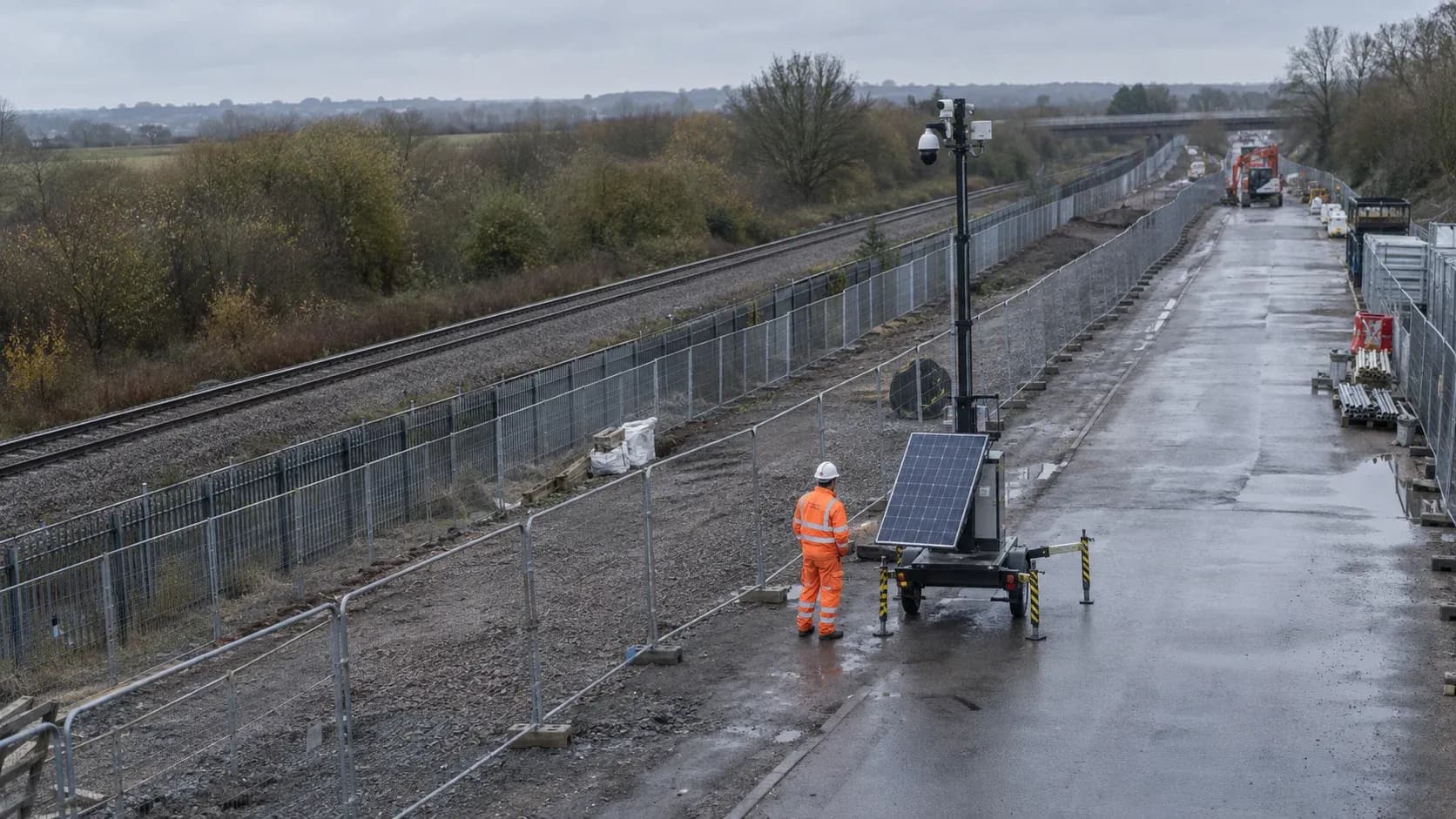
Temporary CCTV towers are the standard option for construction sites because they are self-contained, solar or generator powered, and can be relocated as the build progresses. Ask exactly what a single tower covers in metres, how many towers your perimeter actually needs (not a generic "one tower per site" answer), and how coverage will be re-planned as hoarding lines and compounds move through the programme. A tower quote without a site-specific coverage plan is a guess.
3. Wired or wireless, and why does it matter here?
Wired systems (usually PoE, power over ethernet) are more resilient once installed but need containment and access to run cable, which is harder on a live construction site with shifting compounds. Wireless and cellular-linked systems install faster and relocate easily but depend on signal strength and network resilience (see question 5). The right answer depends on the site's phase: a long-duration groundworks and shell-and-core programme often justifies wired infrastructure, while a short mobilisation or a site with a moving hoarding line usually needs wireless.
4. Will it actually see anything at night?
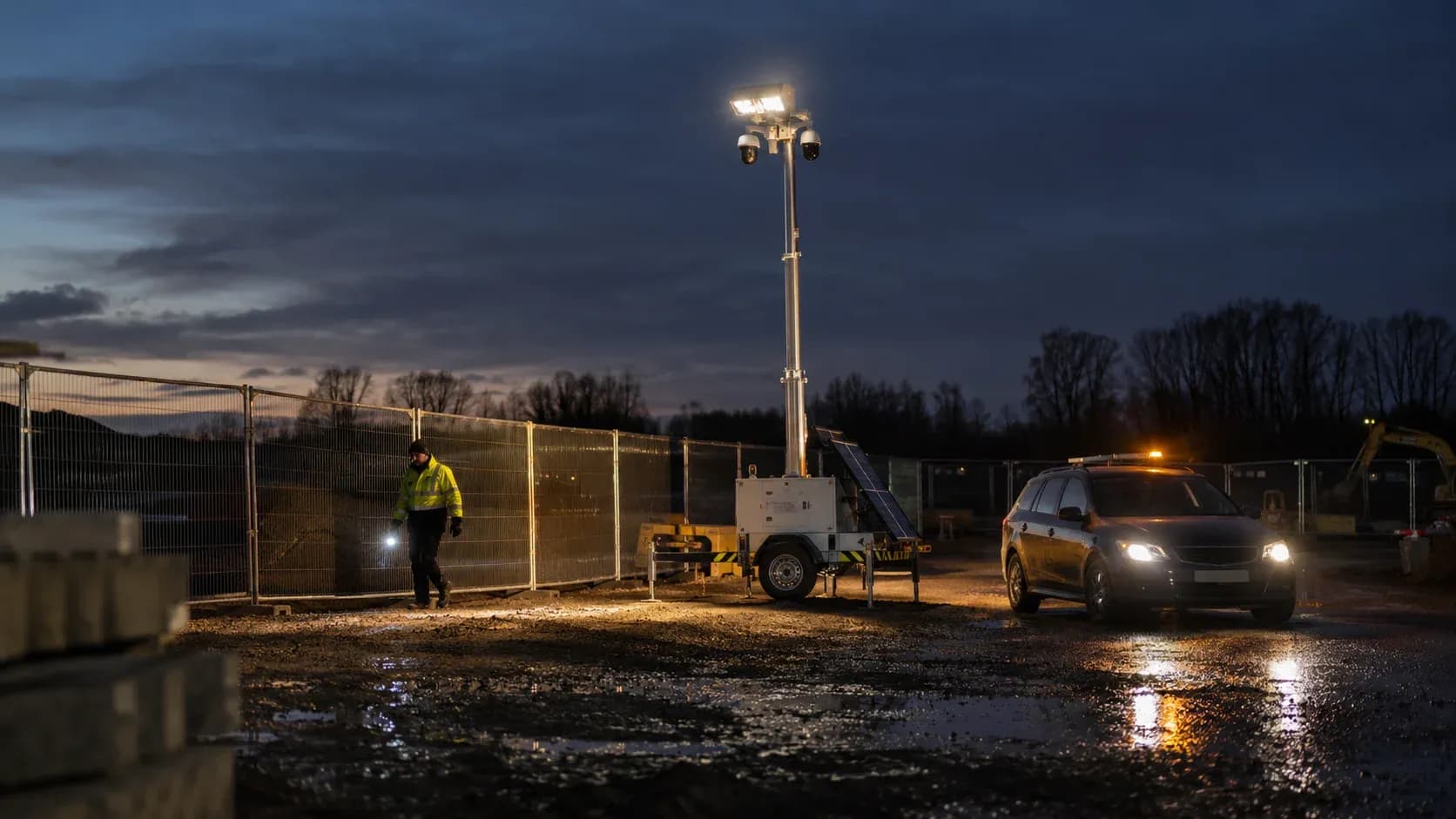
Most theft and intrusion on construction sites happens outside daylight hours, when the site is unattended. Ask specifically what night detection technology is fitted (infrared illumination, thermal, or white-light deterrent lighting triggered by motion) and at what distance it produces usable, evidential-quality footage rather than a grey blur. A camera with no meaningful night performance is a daytime-only deterrent on a site that is most at risk after dark.
5. What happens when the network drops?
Construction sites are notorious for poor or intermittent connectivity, especially on rural, greenfield or basement-level compounds. Ask what the system does when the link to the control room fails: does it buffer footage locally until the connection restores, does it fail over to a secondary network, and does the control room get an alert that a camera has gone offline. A system that silently stops transmitting during an outage gives you a false sense of coverage exactly when you need it most.
6. Who responds to an alert, and how fast?
A verified alarm is only useful if someone acts on it quickly. Ask what the escalation path is: does an operator verify the activation visually before calling anyone, is there a named keyholder or mobile response unit, and what is the target response time. Response times are always location and contract dependent, so treat a generic "we respond fast" answer with scepticism and ask for the actual SLA in writing.
7. Is the system GDPR and ICO compliant?
CCTV on a construction site collects personal data, both of your own workforce and of the public passing the site boundary, so it falls under UK GDPR. The Information Commissioner's Office (ICO) sets out the requirements in its guidance on video surveillance, including CCTV: a documented, proportionate purpose for recording, visible signage, secure storage with a defined retention period, and a process for handling subject access requests.[2] Ask your provider whether the system is configured with a Data Protection Impact Assessment (DPIA) in mind from the outset, not bolted on after a complaint. If the system also feeds into a public authority context or overlaps with facial recognition or ANPR, the separate Surveillance Camera Code of Practice sets further expectations for proportionality and necessity.[3]
8. Who installs it, and who decommissions it?
Installation quality determines whether cameras are actually pointed at the risk (gates, plant compounds, fuel storage, material laydown) rather than a wall. Ask who carries out the site survey and design, whether it is tied to the site's actual risk profile or a standard camera count, and what qualifications the installing engineers hold. Just as important: ask what decommissioning looks like at practical completion, including data wipe, equipment removal and making good any fixings, since this is routinely left out of the original quote and becomes a dispute at handover.
9. What actually drives the cost?
Cost on a CCTV quote is driven by more than the number of cameras: tower or fixed-camera count, wired versus wireless infrastructure, whether recording is local (NVR), cloud-backed, or both, the retention period configured against insurer requirements, and whether monitoring is included or charged separately. Ask for the quote itemised against these drivers rather than a single lump sum, so you can see what you are actually paying for and compare providers on the same basis.
10. Should CCTV replace a guard, or work alongside one?
CCTV and manned guarding solve different problems. A camera, even a monitored one, cannot physically challenge an intruder, check credentials at a gatehouse, or manage a chaotic delivery yard. A guard cannot watch the whole perimeter simultaneously or produce a permanent evidential record. On most active construction sites the two are complementary: CCTV covers the full perimeter continuously and provides the evidence trail, while a guard handles access control, visitor management and physical intervention at the point of entry. Treat "CCTV instead of a guard" as a cost-cutting decision to make deliberately, not a default.
11. How do the main options compare?
| Option | Deterrence | Evidence quality | Response speed | Best suited to |
|---|---|---|---|---|
| Unmonitored recording only | Low to moderate (visible camera acts as deterrent) | Good, but reviewed after the fact | None, footage reviewed retrospectively | Low-risk sites, short mobilisations, budget-constrained phases |
| Monitored CCTV (tower or fixed) | High (active response possible) | Good, time-stamped, verified in real time | Depends on control room and dispatch SLA | Live sites with material, plant or fuel exposure |
| Monitored CCTV with manned guarding | Highest | Highest, camera evidence plus a written incident log | Fastest, physical response on site | High-value sites, high footfall, live/occupied boundaries |
12. What should be in the contract before you sign?
Before appointing a provider, get the answers to questions 1 to 10 in writing as part of the contract or service specification, not as a verbal assurance during the sales call. At minimum, the contract should state: whether monitoring is included and by whom, the coverage plan by tower or camera location, the night detection method, the network resilience and fallback behaviour, the named response path and target time, the data retention period and DPIA position, who installs and who decommissions, and what happens to the equipment and footage at contract end.
What this looks like on an AOG site
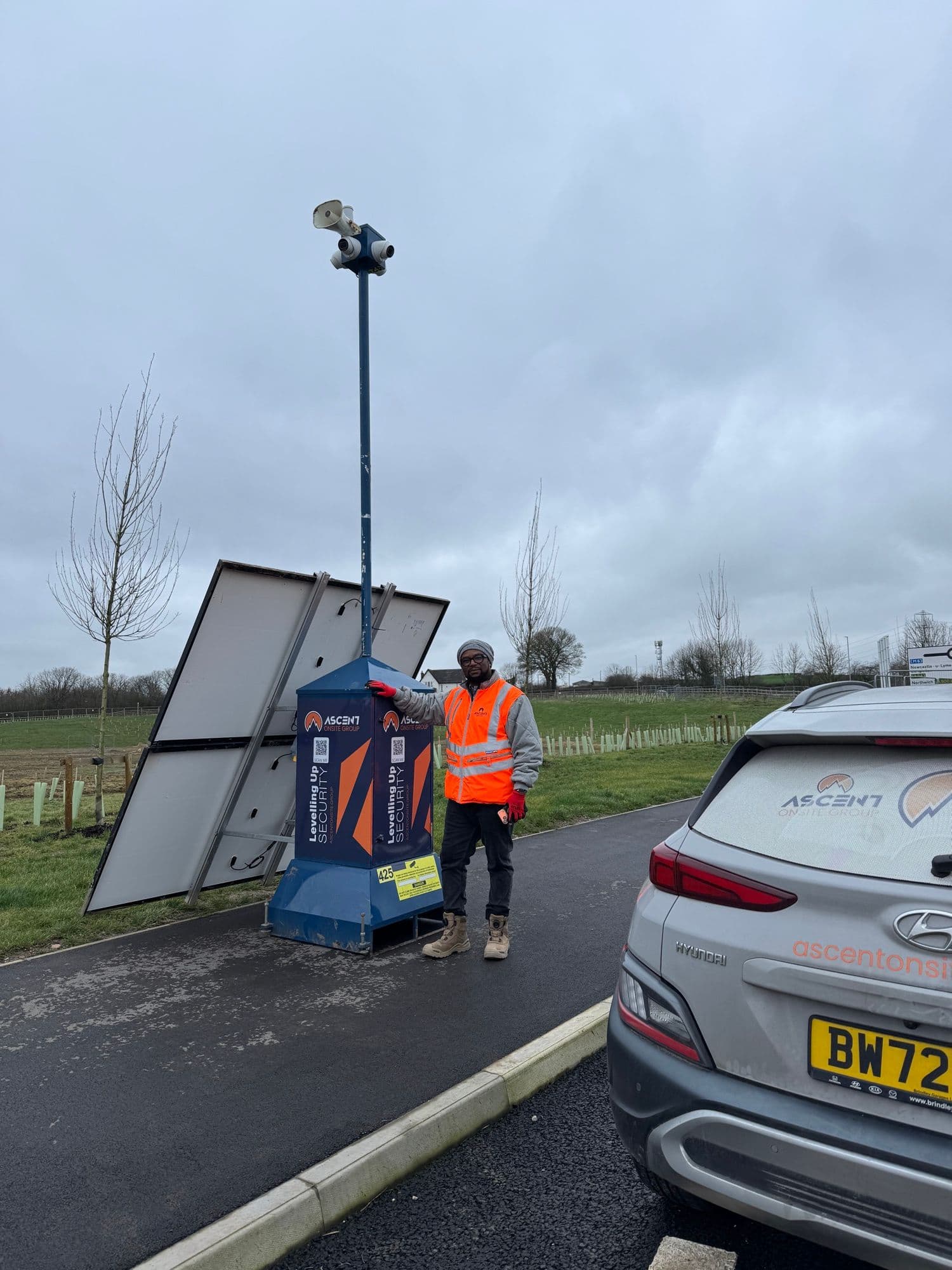
AOG designs CCTV coverage against the site's actual risk profile rather than a standard camera-per-square-metre formula, and every install is integrated with the AOG remote monitoring control room so cameras that go up are actually watched, not just recorded to. Recording runs on local NVR with optional cloud backup configured to insurer retention requirements, and CCTV signage, ICO registration support and DPIA-aligned configuration are built into the design rather than treated as an add-on. Planned preventative maintenance and reactive call-out cover keep the system live under a service contract rather than left to fail silently between visits.
CCTV is one part of a wider security package rather than a standalone purchase. On the Royal Mail hub in Rugby, for example, AOG's security account started on gate manning and police liaison with CCTV-supported evidence for every incident, then grew over three and a half years into a wider multi-division site support contract, all reported through the same weekly review. That is the pattern worth asking a prospective provider about: not just what the camera can see, but how it fits into the rest of your site's protection.
Download the checklist
Construction Site Security Checklist — a free, 5-section checklist covering exactly this. Get the checklist →