

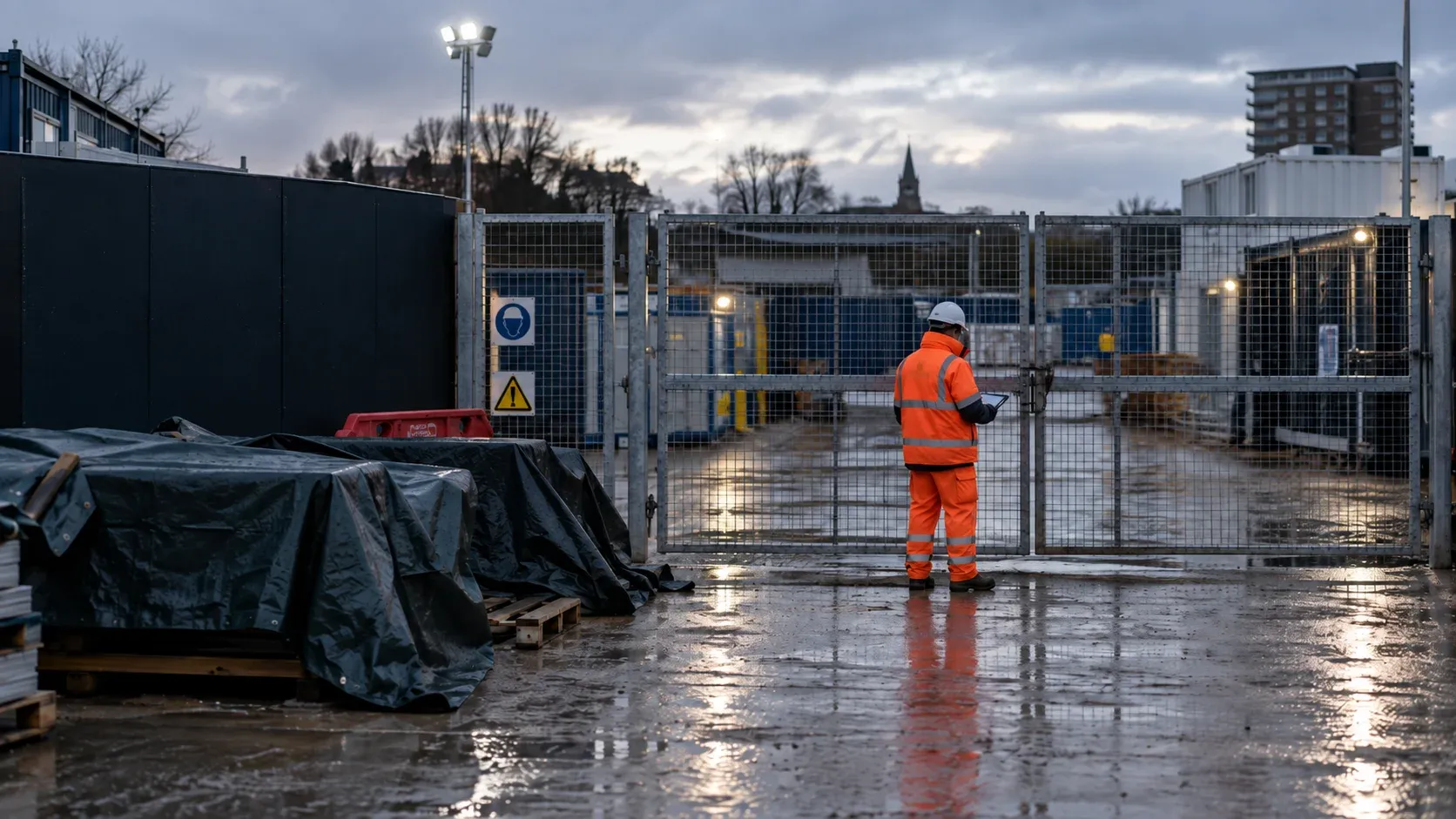
Any extended shutdown, whether it is the Christmas and New Year break, a summer close-down or a phased handover gap, needs four things confirmed before the last person leaves site: security handed to a named keyholder with a documented response plan, fire precautions checked and combustible material cleared, cleaning and waste dealt with before the doors close rather than after they reopen, and high-value plant and materials secured, removed or recorded. Treat this as a checklist worked through days in advance, not a scramble on the last afternoon. Christmas and New Year is the most common and highest-risk example, and it is used throughout this guide, but the same list applies to any period a site or building goes quiet for more than a few days.
Why shutdown periods carry disproportionate risk
A site that is staffed and active every day gets a form of protection for free: people are there, noticing things. Remove that for a week or two and every other control has to work harder on its own. Police guidance jointly published by the National Business Crime Centre and the Metropolitan Police Service specifically calls out extended closures as a higher-risk period, recommending enhanced perimeter checks, tested alarm systems and regular inspections through the closure rather than treating it as time nobody needs to think about the site.1] Water systems left standing with no or reduced use, in welfare cabins or partially fitted-out buildings, also carry a specific health risk: stagnant water in pipework is a known condition for legionella bacteria to develop, which is why the Health and Safety Executive's guidance requires anyone in control of a water system to keep assessing and managing that risk, closure or no closure.[2] Security is covered at more length in AOG's companion guide, [Winter Construction Site Security: CCTV, Guarding and Shutdown Planning; this checklist is the cross-division view.
Security: before you lock the gate
- Appoint a named keyholder with a documented, verified response process and a target attendance time agreed in writing, not left to whoever is free over the break
- Carry out a final perimeter and hoarding check, confirming no gaps, damaged panels or unsecured access points before the site closes
- Test alarm systems and confirm monitored response is active for the full closure period
- Secure or remove high-value plant, tools and materials from open compounds rather than leaving them under a tarpaulin
- Keep CCTV recording and, where the risk justifies it, monitored, for the duration of the closure, not just the working day
- Log the closure itself: date, time, who carried out the final walk-round, and what was checked
Fire: reducing risk when no one is walking the floors
The Regulatory Reform (Fire Safety) Order 2005 puts a duty on the "responsible person" for a building or site to manage fire risk, and that duty does not pause because the site or building is closed.[3] Official guidance on fire safety for premises that are temporarily unoccupied or have reduced activity points to a consistent set of practical steps: remove or reduce combustible waste and materials, particularly anything stored close to a boundary or external wall, check that fire doors are closed and not wedged open, isolate non-essential electrical equipment, and keep escape routes and fire-fighting access clear even though nobody is expected to use them during the closure.[4]
- Clear combustible waste, packaging and offcuts from site, not just from inside welfare units
- Confirm fire doors are closed and unobstructed, and any temporary fire alarm or detection system is left active
- Isolate non-essential electrical equipment and check nothing is left on charge unattended
- Keep site access clear for the fire service in an emergency, even with the gate locked
- Where hot works have taken place close to the shutdown, follow the standard hot works permit cool-down period before the site is left unattended
- Record the pre-closure fire check alongside the security walk-round, as one document, not two
Cleaning and waste: don't let the site come back to a mess or a hazard
A site or building left with food waste, general rubbish or uncleared skips over an extended closure is not just untidy. It is a pest attractant and, in occupied buildings, a hygiene issue the moment people come back. Every business handling waste has a duty of care under the Environmental Protection Act 1990 to store it safely and pass it only to an authorised carrier, with a waste transfer note kept as evidence, and that duty does not go on hold because the site is shutting for a fortnight.[5] Practically, that means clearing general and food waste before the closure, not scheduling the first collection for the week after reopening.
- Clear general waste, food waste and packaging from welfare units and site before closure, with waste transfer notes held for anything removed
- Carry out a pre-closure clean of welfare facilities, canteens and any occupied office space, so the site reopens ready to work rather than needing an unplanned deep clean first
- Empty and, where appropriate, defrost catering equipment in welfare units
- Check drainage and gullies are clear, particularly ahead of a winter closure when standing water can freeze
- If water systems in welfare cabins or partially occupied buildings will see no or reduced use over the closure, flag this to whoever holds responsibility for legionella risk management on the project, so the system is checked and, if needed, flushed on reopening
Asset protection: plant, materials and the paper trail
The dilapidation and condition survey that AOG's site set-up and close-down service carries out at programme start and completion is the same discipline that protects a site through a shutdown: photographic, time-stamped evidence of what was on site and its condition, taken immediately before closure. That record does two things. It gives the principal contractor a defensible position if something goes missing or is damaged during the closure, and it removes any dispute about condition when the site reopens. Where a shutdown coincides with a change of contractor, sub-contractor or the end of a hire period, this survey matters even more, since it is the only independent record of what was actually there.
- Photograph and log plant, materials and compound condition immediately before closure, referenced to a plan or location
- Register high-value plant with a recognised equipment marking and registration scheme so it can be traced if stolen
- Confirm hired plant and equipment due for return has actually gone back before the closure, rather than sitting on site accruing hire charges
- Check the site's insurance position covers an unattended closure period of the length planned, and notify the insurer or broker if the closure is longer than a standard policy assumes
- Agree and document who is responsible for the site during the closure: the main contractor, a specific sub-contractor, or a security and FM provider covering the full scope
Shutdown checklist at a glance
- Security: keyholder confirmed, perimeter checked, alarms tested, high-value items secured or removed
- Fire: combustible waste cleared, fire doors checked, non-essential power isolated, escape routes kept clear
- Cleaning and waste: general and food waste cleared, welfare facilities cleaned, waste transfer notes held, drainage checked
- Asset protection: condition survey and photographs taken, plant registered or returned, insurance position confirmed, responsibility for the closure agreed in writing
This guide is reviewed and refreshed each autumn ahead of the winter shutdown season, with the checklist and cited guidance checked against the latest published sources before republication.
Download the checklist
Construction Site Shutdown Checklist — a free, 4-section checklist covering exactly this. Get the checklist →
References
- Construction Site Security Guidance, National Business Crime Centre and Metropolitan Police Service, with the Considerate Constructors Scheme, accessed 2026-09-02
- Legionella and Legionnaires' disease, Health and Safety Executive, accessed 2026-09-02
- The Regulatory Reform (Fire Safety) Order 2005, legislation.gov.uk, accessed 2026-09-02
- A guide to making your small non-domestic premises safe from fire, GOV.UK / Home Office, accessed 2026-09-02
- Waste duty of care: code of practice, GOV.UK, accessed 2026-09-02
